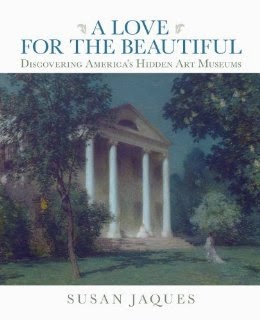
Globe Pequot Press. 2012. c288p. illus. index. ISBN 978-0-7627-7950-5. $19.95.
In this lavishly-illustrated (more than 250 full-color photographs) guide, Jaques (Bachelor of Arts, History, Stanford University; Master of Business Administration, University of California at Los Angeles), a journalist specializing in art and travel and a gallery docent at The J. Paul Getty Museum, introduces readers to art collections in fifty lesser-known American museums. Covering museums in thirty-one states with “geography” factoring into her selection process, the author showcases “diverse” museum collections that remain “hidden” or “under-the-radar” to many museum goers, even though they may be located on the “beaten path” or in “plain sight.” (p. xii) Not known for their blockbuster exhibitions or encyclopedic holdings, these “unsung,” “largely unknown” museums constitute “collecting” museums that display “extraordinary” art from their permanent collections and “tend to be exceptional in specific areas.” (pp. xii-xiii) They typically offer “unique” art-viewing experiences that are “genuine, intimate, and uncrowded.” (p. xii) Jaques organizes her book into fifteen chapters, each of which features three or four museums that have extraordinary collections in certain areas. She titles chapters: African, Pre-Columbian & Oceanic Art; American Art; Ancient Art; Asian Art; Contemporary Art; Decorative Arts, Design & Craft; European Painting, Eighteenth to Twentieth Century; Medieval, Renaissance & Baroque Art; Modern Art; Native American & Western Art; Photography; Sculpture; Single-Artists; and Spanish & Latin American Art. In each entry for a museum, Jaques describes the museum, its founder(s), buildings, collections, and history. The author also sets forth each institution’s address, contact information, website, hours of operation, and admission fee(s) as well as briefly highlights a few of its “must see” pieces. Of interest mostly to art lovers and travelers, this accessible, artfully- designed, engaging, informative, nicely- written, thoughtful, and well-presented publication by an experienced writer, traveler, and museum aficionado may be read from cover-to-cover and/or consulted by chapter and/or entry. While Jaques’s selection criteria and classification scheme may seem too arbitrary, inexplicit, personal, subjective, and/or superimposed for some readers, this book nevertheless belongs in many public, academic, and special libraries. It is recommended for individual readers as well as for library reference collections. Review copy. Availability: Amazon, Barnes & Noble.com
Sunday, September 1, 2013
Monday, November 12, 2012
Stevens, Ann and Kelly, Giles. Diplomatic Gardens of Washington.
Schiffer Publishing, Ltd.. 2012. c128p. illus. bibliog. ISBN 978-0-7643-3978-3. $34.99.
In this generously-illustrated (168 color images) publication, Stevens, a widely published photographer, and Kelly, a retired US diplomat and naval officer, take readers on an exclusive, armchair traveler’s tour of twelve embassy gardens in Washington, DC. In twelve chapters, each of which showcases a different garden, they cover the best- kept embassy gardens of Washington, which are rarely open to the public. Focusing on the Ambassadors’ gardens of Australia, Britain, Denmark, the European Union, France, the Federal Republic of Germany, the Apostolic Nunciature of the Holy See, Italy, the Republic of Korea, the Royal Netherlands, Norway, and Sweden, Stevens and Kelly provide historical facts about the properties, the Ambassadors’ residences, and chanceries. They detail the unique, cultural and diplomatic histories of the gardens, their designs, features, trees, and plants. Stevens and Kelly illustrate their text by means of color photographs, many of which are full-page and further document the features, trees, and plants of the gardens. Each chapter includes many photographs, with fourteen being the average. Visually engaging, artfully designed, thoughtfully written, and intuitively presented, based upon the organization of each garden within its embassy compound, this book may interest garden lovers, horticulturalists, students, scholars, professionals, and others. Including a one- page foreword by the Executive Director of the United States Botanic Garden, Holly H. Shimizu, a table of contents, photographic captions, and bibliography, it constitutes a sufficiently well-documented addition to the literature on gardens and garden history. As a basic resource on some of the diplomatic gardens of Washington, DC, it is highly recommended for many types of libraries, not limited to large public and special libraries. Review copy. Availability: Amazon.com, Barnes & Noble.com, Schiffer Publishing Ltd.
Friday, October 5, 2012
Restemeyer, Virginia and Weiner, E. I.. Hip & Hidden Philadelphia: the Unexpected House in a City of Tradition.
Probasco Haus Press. 2012. c176p. illus. bibliog. index. ISBN 978-0-9766626-2-4. $29.95.
Approaching their subject from two rubrics-- a lot can be learned about the inhabitants of a city from the buildings in which they live and the personality of a city is reflected in the architecture of inhabitants’ houses-- two longtime residents and “flaneurs” of Philadelphia, who write and edit several websites and blogs dedicated to art, architecture, landscape, and the study of placeness (hipandhidden.com , arslocii.com , hipandhidden.wordpress.com , arslocii.wordpress.com), take readers on an armchair traveler’s tour of the “other” Philadelphia, the “other” Philadelphia that can be found “inside” the Philadelphia we know from the news and its towering constructions, including condominiums, apartment buildings, and skyscrapers. Restemeyer—-an artist, designer, publisher, and writer-- and Weiner—-an author, editor, journalist, photographer, and writer-- showcase the “other” Philadelphia that may be characterized as “amazing,” “daring,” “different,” extra-“ordinary,” “hidden,” “one-of-a-kind,” “one-off,” “random,” “subtle,” “subversive,” “sudden,” “unique,” and “unusual.” (Probasco Haus Press Release) They define the “other” Philadelphia as the “hip and hidden” one that defies simple definition (pp. 5-7) yet is comprised of “unexpected” homes in a “city of tradition.” In an introduction and eleven chapters, the authors attempt to reveal houses in Philadelphia that fall outside the norms of 18th, 19th, and 20th century architectural styles and developments evidenced by the familiar brick row houses and twins that can be found throughout the city. Spotlighting nearly 100 properties, all of which are located within the city’s limits (p. 6), Restemeyer and Weiner group the residential structures into chapters according to eleven “hip and hidden” categories they developed while walking the city and researching their book: the Classics, Adaptive Reuse, Incorporated Past, Facelift, Pioneers, Quirky Individualism, House=Site, Artistic Assertion, Modernist Assertion, The Referenced Past, and Unique Comparables. As addenda, in lieu of a back-of-the-book index, they include a Neighborhood Guide, citing the pages upon which houses in particular neighborhoods are discussed, as well as an Architects and Builders List, referencing the pages upon which the works by certain architects and builders are mentioned. Whether the authors successfully fulfill one of their goals to document Philadelphia’s “essential hip and hidden” houses remains to be adjudged by readers, who must grapple with the authors’ categories as well as the plethora of stylistic concepts and terms that they use to present the “hip and hidden” houses in Philadelphia. In need of at least a glossary defining artistic styles and terms, the strength of this publication rests on its original, artful, individualistically- focused examinations of various residential structures in Philadelphia. Each house is described in considerable detail by the authors by means of insightful commentary and oftentimes by three or more color photographs illustrating its features on double-page spreads. Generously-illustrated, with more than 400 high-quality, color photographs, and professionally- presented, with careful attention to design, layout and prose, this publication will interest some general readers, students, and others. A subset of readers, most likely those with little free time to walk through the city and/or those possessing a rudimentary to intermediate knowledge of the city’s complex architectural palimpsest, may find the absence of addresses or even a map documenting the presences of structures frustrating and contrary to the authors’ intentions of encouraging readers to “explore” and “find” the houses in the “general Philadelphia neighborhoods” in which they are situated. (p. 9) Due to its original approach to its subject and its significance as a book documenting the more unusual residential structures in a large, northeastern, American city with a distinguished architectural history, this book is highly recommended for large public and special library collections, particularly for those found in the Philadelphia and Delaware Valley region. Purchased review copy. Availability: Probasco House Press and selected fine bookstores
Saturday, May 5, 2012
Spencer, Donald D.. Greetings from Sarasota, Florida: Bradenton & Surrounding Communities.
Schiffer Publishing Ltd.. 2009. 128p. illus. bibliog. index. ISBN 978-0-7643-3213-5. $24.99
In this generously- illustrated (375 color images) publication, the base of which was formed from the author’s postcard, photograph, and memorabilia collections, Spencer (Ph.D., Computer Science), a renowned educator and writer, who has written over 200 books, many of which pertain to Florida, takes readers on a predominantly visual tour of Sarasota, Bradenton, and their surrounding communities. In the preface and part one of four, Spencer covers the early history of postcards, Florida, and the Sarasota-Bradenton area. In parts two and three, each of which is comprised of three chapters and forms the heart of the book, the author provides overviews of Sarasota and Bradenton as well as showcases their attractions, beaches, bridges, hotels, parks, public buildings, schools, streets, transportation networks, and more. Featured mostly by means of postcard reproductions and their captions, “places to go and things to do,” many of which still exist, include Braden Castle, Bradenton Beach, Cars of Yesterday (now the Sarasota Classic Car Museum), Circus Hall of Fame, De Soto National Memorial, The Gamble Plantation, Marie Selby Botanical Gardens, Ringling Brothers and Barnum & Bailey Circus Winter Quarters, Lido Beach, The John and Mable Ringling Museum of Art, Sarasota High School (the future home of the Sarasota Museum of Art), Sarasota Jungle Gardens, Siesta Key Beach, and the Sunshine Skyway Bridge. In part four, consisting of six very short chapters, averaging three pages each, Spencer sets forth descriptions and images pertaining to nearby communities, not limited to Anna Marie Island, Arcadia, Punta Gorda, Sebring, and Venice. Postcard reproductions are captioned, with their dates and values also noted, thereby making this a valuable resource for collectors. Of interest to general readers, residents, tourists, collectors, and others, this colorful, nicely-presented book, with a bibliography, index, and more, belongs in public and special libraries. Review copy. Availability: Amazon.com, Barnes & Noble.com, Schiffer Books
Friday, May 4, 2012
Couch, Dale L., ed.. Neighboring Voices: the Decorative Culture of Our Southern Cousins: the Fifth Henry D. Green Symposium of the Decorative Arts, Georgia Museum of Art, Athens, Georgia, January 29-30, 2010.
Georgia Museum of Art, University of Georgia. 2011. 111p. illus. ISBN 978-0-9159-7776-5. $25.00.
Marking the occasion of the Fifth Henry D. Green Symposium of the Decorative Arts, hosted by the Georgia Museum of Art in 2010 in Athens, GA, this generously-illustrated (more than 50 color reproductions) compilation of selected papers and commentaries pertains to the theme of “neighboring voices,” the nexus of the decorative arts and craftsmanship in Georgia and its nearby "southern" states. Nine contributors, including art dealers, curators, independent scholars, museum professionals, university professors, and others, present seven essays on pertinent subjects. In his essay entitled, “Georgia on Our Mind,” Robert A. Leath features decorative arts objects and installations that comprise the collections at the Museum of Early Southern Decorative Arts (MESDA) in Winston-Salem, NC. Carol Crowe Carraco and Linda Crowe Chesnut showcase White Oak Plantation house and its furnishings as they previously existed in Oglethorpe County, GA. Charlotte M. Crabtree discusses the career and works of the Methodist silversmith John Mood (active 1859-1891), who eventually settled in Charleston, SC. Robert Doares and Barbara Wood examine the connections of Haviland porcelain to the Antebellum southern states while Joey J. Brackner sets forth his findings on the influence of Georgians on Alabama folk pottery. Finally, June Lucas presents a recently-discovered, paint-decorated, chest from North Carolina (c. 1850-1860) that bears aesthetic similarities to pieces from the Georgia Piedmont. Dale L. Couch compares the Johnson chest discussed in Lucas’s article to a well-documented, painted Georgia chest (c. 1839) that belonged to Mary Cronic. Filled with colorful photographs, this well- presented book will interest students, scholars, museum professionals, and others. It belongs in large public, special, and academic, research-oriented book collections. Review copy. Availability: Amazon.com, Georgia Museum of Art Shop
Sunday, April 8, 2012
Callahan, Ashley. Georgia Bellflowers: the Furniture of Henry Eugene Thomas.
Georgia Museum of Art at the University of Georgia. 2011. c107p. illus. bibliog. index. ISBN 9780915977772. $16.00
Accompanying an exhibition by the same name, held at the Georgia Museum of Art in Athens, GA until the 15th April 2012, this small (8 ¼ X 6 ¼ ins.), generously- illustrated (more than 40 black- and- white and color illustrations), attractive catalog presents the life and work of Henry Eugene Thomas (1883-1965), a Georgia antiques dealer and furniture maker, who rose to prominence during the early decades of the twentieth century, first as an Athens’s antiques dealer or picker and then as a cabinetmaker, restoring and reproducing antiques from the Piedmont area of Georgia for local and nonlocal customers. Known to have shaped the collecting and understanding of the Georgia decorative arts, Thomas became a significant craftsman, who created a recognizable, regional, Colonial revival style from the 1920s through the 1950s. Featuring an essay by independent scholar and guest curator, Callahan, as well as an unpublished manuscript about the artist, written by his only son Jack Thomas, this book, like the exhibition, is the first to highlight the career and works of Henry Eugene Thomas. Among many topics, Callahan sets forth previously unpublished information about the history of the study of the decorative arts in the Southeast and Henry Eugene Thomas’s roles in the Colonial Revival in the Southeast. While showcasing the artist’s works, not limited to his breakfronts, chests, clocks, desks, end tables, cabinets, coffee tables, and more, she seeks to elucidate Thomas’s approach to restoring and reproducing the antiques that he discovered and made as well as contextualize his creations within their aesthetic, social, and cultural milieus. Of interest to students, collectors, museum professionals, scholars, and others, this book also includes endnotes and a Checklist of works and selected ephemera featured in the exhibition. Nicely- presented and well- written, it is highly recommended for large public, academic, and special libraries as well as for Southeastern library collections. Review copy. Availability: Amazon.com
Thursday, November 24, 2011
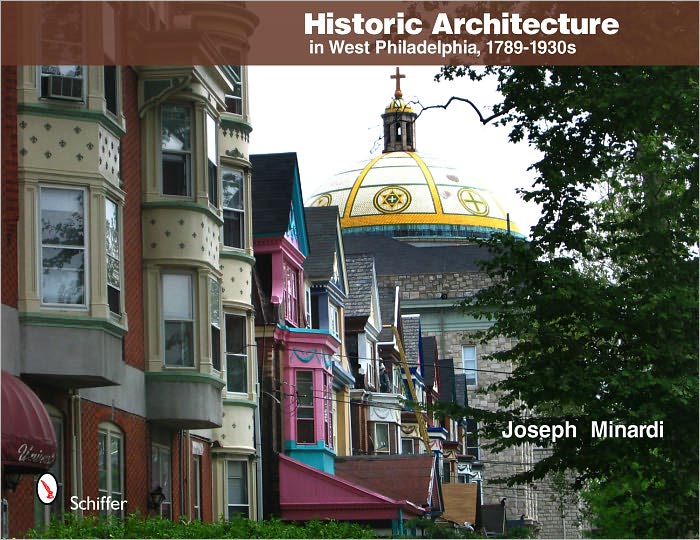
Minardi, Joseph. Historic Architecture in West Philadelphia, 1789-1930s.
Schiffer Publishing. 2011. c192p. illus. maps. bibliog. index. ISBN 978-0-7643-3771-0. $50.00.
For many residents of Philadelphia, PA, West Philadelphia, the area situated west of the Schuylkill River that once was Blockley and Kingsessing Townships, is comprised of a cluster of at least seven neighborhoods, including the Woodlands, University City, Spruce Hill, Cedar Park, Squirrel Hill, Garden Court, Walnut Hill, and Powelton Village. Originally a collection of farms and hamlets along the Schuylkill River, West Philadelphia grew into a streetcar suburb of Philadelphia during the mid-19th century, when it was incorporated into the City of Philadelphia. Today West Philadelphia is a thriving locality, made up of residents, businesses, and esteemed institutions of higher education, not limited to Drexel University and The University of Pennsylvania. In this architectural history of West Philadelphia and the architects who made it happen, one of the first, nearly comprehensive, largely pictorial examinations since the comparable West Philadelphia Illustrated by Vieira M. Laffitte was published in 1903 (p. 5), Minardi, a graphic designer (p. 5), award-winning photographer (recipient of the 2007 Preservation Initiative Award, University City Historical Society), and resident of Philadelphia (inside back book cover), takes readers on a historical, visual tour of West Philadelphia’s neighborhoods and its buildings, constructed between the late eighteenth and early twentieth-centuries. In nine chapters, the author presents brief historical overviews of West Philadelphia’ s neighborhoods as well as more than 500 images illustrating the various architectural structures comprising them. Minardi showcases apartment buildings, churches, charitable institutions, clubs, colleges, housing developments, homes, inns, libraries, monuments, universities, row houses, schools, stadiums, train stations, and more. In chapter nine, the author features alphabetically-arranged biographies of selected architects and their firms. Thoughtfully-presented and very generously-illustrated, with archival images, maps, and many color photographs taken by Minardi, this well-written, easy-to-read, accessible, engaging publication provides an excellent introduction to the historical architecture of West Philadelphia. Sufficiently well-documented, with image captions, including building names, addresses, and styles, back-of-the-book endnotes, a bibliography, and an index, it only lacks a chronology, maps keying the various architectural landmarks on them, an index of buildings by street addresses, and appendices containing suggested, brief, walking or driving tours of the featured neighborhoods, all of which further would have enhanced the subject and the its presentation. Constituting a visual feast of exterior and interior views of many historic edifices in West Philadelphia, this book is sure to delight, inform, and educate Philadelphians, general readers, students, scholars, architects, urban planners, historians, professionals, and others. It is very highly recommended for local and large public libraries as well as for academic and special libraries. Review copy. Availability: Amazon.com, Barnes & Noble.com
Subscribe to:
Posts (Atom)